
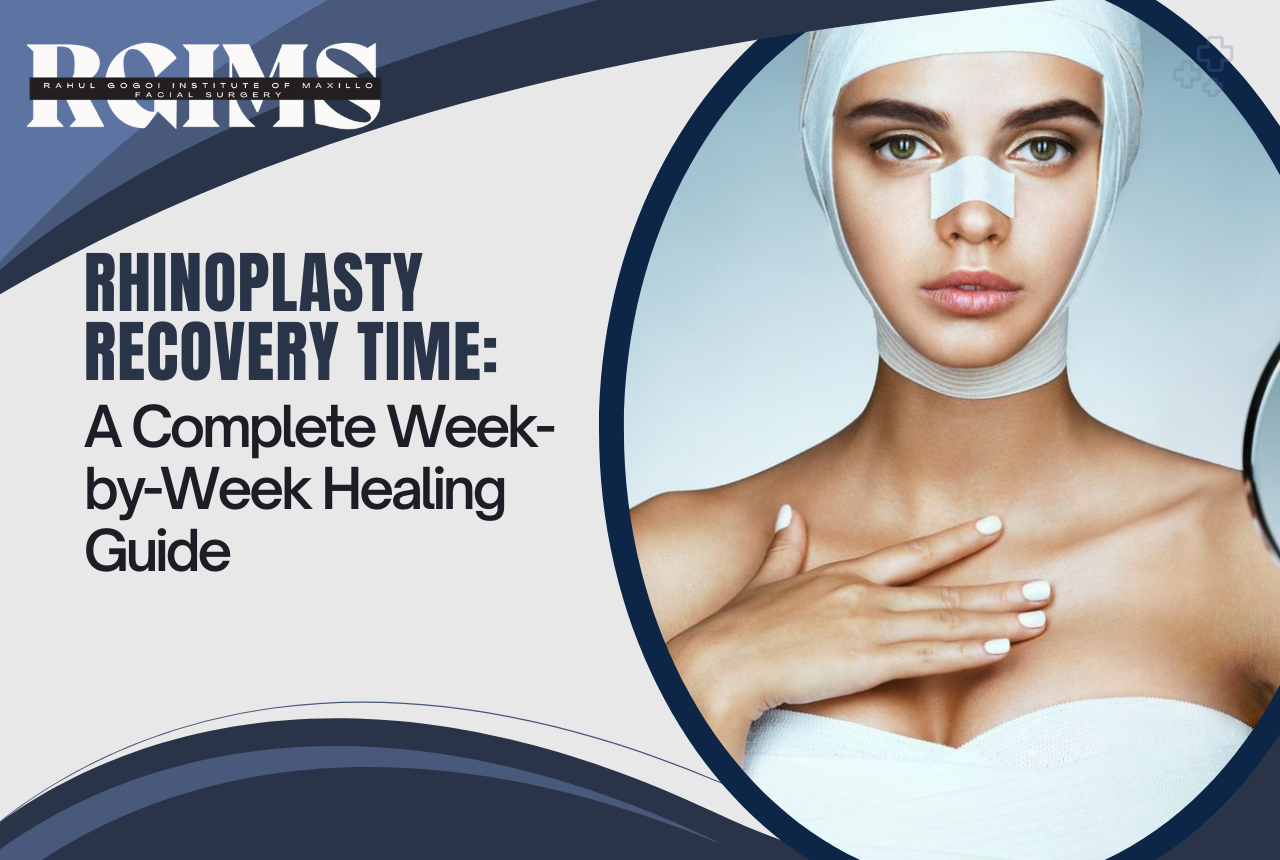
If you are considering a nose reshaping procedure, one of the first questions you will ask is simple: how long is the rhinoplasty recovery time? The honest answer has two parts. You will look and feel presentable within about one to two weeks, but your nose continues to refine quietly for up to a year or more. Understanding this timeline helps you plan time off, set realistic expectations and heal with confidence.
At RGIMS, Guwahati, facial plastic surgeon Dr. Rahul Gogoi guides every patient through a structured, well-supported recovery. This guide breaks down exactly what to expect at each stage, the factors that influence healing, practical aftercare tips and answers to the questions patients ask most.
Rhinoplasty recovery timeline at a glance
| Stage | What to expect |
| First 48 hours | Splint/cast in place, congestion, mild discomfort, some bruising and swelling around the eyes and cheeks. Rest with the head elevated. |
| Days 3–7 | Swelling and bruising peak around day 2–3 then begin to fade. Comfort improves daily. Splint usually removed at day 5–7. |
| Week 2 | Most visible bruising is gone. Many patients feel ready to return to work and gentle social activity. |
| Weeks 3–6 | Light exercise gradually resumes. Avoid glasses on the nose bridge, heavy lifting and contact sports. |
| Months 2–3 | Around 80–90% of swelling has resolved. The nose looks much more natural. Most activity is unrestricted. |
| Months 6–18 | Subtle tip swelling continues to settle. The final, refined result becomes fully visible, typically by 12–18 months. |
Rhinoplasty recovery week by week (in detail)
The first 24–48 hours
Immediately after surgery you will have a protective splint over the nose and, in some cases, soft internal supports. Expect a stuffy, blocked-nose feeling, mild swelling and bruising around the eyes, and some oozing on the first day. This is normal. Rest, keep your head elevated, apply cold compresses to the cheeks and eyes (not directly on the nose), and take medication as prescribed.
Days 3 to 7
Swelling and bruising typically peak around the second or third day and then start to recede. Each day feels noticeably better. Around day five to seven, your surgeon removes the splint — a turning point when many patients get their first real look at the new shape. Remember the nose will still be swollen at this stage.
Week 2
By the end of the second week, most visible bruising has resolved and any residual discoloration can usually be covered with light make-up. This is when most patients feel comfortable returning to work and meeting people again. The nose will still feel firm and slightly swollen, especially at the tip.
Weeks 3 to 6
You can gradually reintroduce light cardiovascular exercise such as walking and gentle cycling, building up as your surgeon advises. Continue to avoid heavy lifting, straining, contact sports and resting glasses on the bridge of your nose. Numbness and tightness slowly fade during this period.
Months 2 to 3
By around three months, roughly 80 to 90 percent of the swelling has settled. The nose looks far more natural and most daily restrictions are lifted. Many patients feel their result is largely “there,” even though fine refinement continues.
Months 6 to 18
The nasal tip has the thickest skin and is the last area to fully de-swell. During this final phase, small changes continue quietly until the nose reaches its settled, refined shape. For most patients the true final result is visible between twelve and eighteen months after surgery.
What factors affect your rhinoplasty recovery time?
No two recoveries are identical. Several factors influence how quickly you heal:
- Type of surgery: open rhinoplasty often involves slightly more initial swelling than closed rhinoplasty because of the small bridging incision.
- Primary vs revision: revision rhinoplasty works through existing scar tissue, so healing and final settling generally take longer.
- Skin thickness: thicker skin tends to hold swelling longer, especially at the tip.
- Extent of the procedure: bone work and major reshaping usually mean more swelling than minor tip refinements.
- Your overall health: nutrition, age, sleep and a non-smoking status all support faster, smoother healing.
- Aftercare compliance: following your surgeon’s instructions closely is one of the biggest levers you control.
Open vs closed rhinoplasty: does recovery differ?
Both approaches share a similar overall timeline. Closed rhinoplasty uses incisions inside the nostrils, so there is no visible external scar. Open rhinoplasty adds a tiny incision across the columella (the strip of tissue between the nostrils), which gives the surgeon greater visibility for complex reshaping. This can mean marginally more early swelling, but the scar typically fades to near-invisible. Dr. Gogoi selects the approach based on your anatomy and goals.
Revision rhinoplasty recovery
Revision (or secondary) rhinoplasty corrects or improves the result of a previous nose surgery. Because the surgeon works through scar tissue and altered structures, swelling can be more persistent and the nose may take longer to reveal its final shape — often up to eighteen months or more. Patience and close follow-up are especially important after a revision procedure.
Warning signs: when to call your surgeon
Some swelling, bruising and congestion are expected. Contact your surgical team promptly if you notice any of the following:
- Heavy or persistent bleeding that does not slow down.
- Fever, increasing redness, warmth or pus, which may signal infection.
- Severe pain not relieved by your prescribed medication.
- Sudden, worsening swelling on one side after it had been improving.
- Any symptom that worries you — when in doubt, it is always safer to ask.
Why choose RGIMS in Guwahati for your rhinoplasty
Dr. Rahul Gogoi leads RGIMS, a dedicated aesthetic, maxillofacial, dental and cosmetic surgery clinic in Guwahati. With a focus on facial plastic and reconstructive surgery, the clinic offers rhinoplasty, revision rhinoplasty, facelift, blepharoplasty, jaw contouring, chin surgery and orthognathic surgery, alongside non-surgical options such as Botox, fillers, PRP and advanced skincare.
A structured recovery plan, attentive follow-up and clear aftercare guidance are central to the RGIMS approach — helping you heal comfortably and enjoy a natural-looking result.
Recommended internal links (for the live page):
Warning signs: when to call your surgeon
Some swelling, bruising and congestion are expected. Contact your surgical team promptly if you notice any of the following:
- Heavy or persistent bleeding that does not slow down.
- Fever, increasing redness, warmth or pus, which may signal infection.
- Severe pain not relieved by your prescribed medication.
- Sudden, worsening swelling on one side after it had been improving.
- Any symptom that worries you — when in doubt, it is always safer to ask.
Why choose RGIMS in Guwahati for your rhinoplasty
Dr. Rahul Gogoi leads RGIMS, a dedicated aesthetic, maxillofacial, dental and cosmetic surgery clinic in Guwahati. With a focus on facial plastic and reconstructive surgery, the clinic offers rhinoplasty, revision rhinoplasty, facelift, blepharoplasty, jaw contouring, chin surgery and orthognathic surgery, alongside non-surgical options such as Botox, fillers, PRP and advanced skincare.
A structured recovery plan, attentive follow-up and clear aftercare guidance are central to the RGIMS approach — helping you heal comfortably and enjoy a natural-looking result.
Frequently asked questions about rhinoplasty recovery time
How long does rhinoplasty recovery take?
Most patients feel presentable within 1 to 2 weeks once the splint and bruising are gone, and can return to normal daily life by then. However, complete internal healing and the final refined shape of the nose can take anywhere from 12 to 18 months as the deepest swelling slowly resolves.
When can I return to work after a nose job?
If you have a desk-based or non-strenuous job, you can usually return to work about 7 to 10 days after surgery, once the external splint is removed and visible bruising has faded. Physically demanding jobs may require 2 to 3 weeks off.
How long does swelling last after rhinoplasty?
The most obvious swelling subsides within the first 2 to 3 weeks. Around 80 to 90 percent of swelling typically settles within 3 months, while subtle residual swelling at the nasal tip can take up to a year or more to fully disappear.
When can I exercise after rhinoplasty?
Light walking can begin within a few days, but strenuous exercise, heavy lifting and high-impact activities should be avoided for about 3 to 6 weeks. Contact sports should usually be postponed for several months. Always follow your surgeon’s specific clearance.
Is rhinoplasty recovery painful?
Most patients describe the experience as discomfort and congestion rather than severe pain. Mild aching, a blocked-nose sensation and tenderness are common in the first few days and are generally well controlled with prescribed medication.
When can I wear glasses after rhinoplasty?
Glasses and sunglasses should be kept off the bridge of the nose for around 4 to 6 weeks, since their weight can affect the healing bones and cartilage. Your surgeon may suggest taping techniques or contact lenses in the meantime.
Does revision rhinoplasty take longer to heal?
Yes. Because revision rhinoplasty works through existing scar tissue and altered anatomy, swelling can be more stubborn and the final result may take longer to settle, often up to 18 months or more.
When will I see the final results of my rhinoplasty?
You will notice a clear improvement once the splint comes off, but the nose continues to refine for many months. Final, settled results are usually appreciated between 12 and 18 months after surgery.
How should I sleep after rhinoplasty?
Sleep on your back with your head elevated on two or three pillows for the first few weeks. This reduces swelling and helps protect the nose. Avoid sleeping on your side or face until your surgeon advises it is safe.