
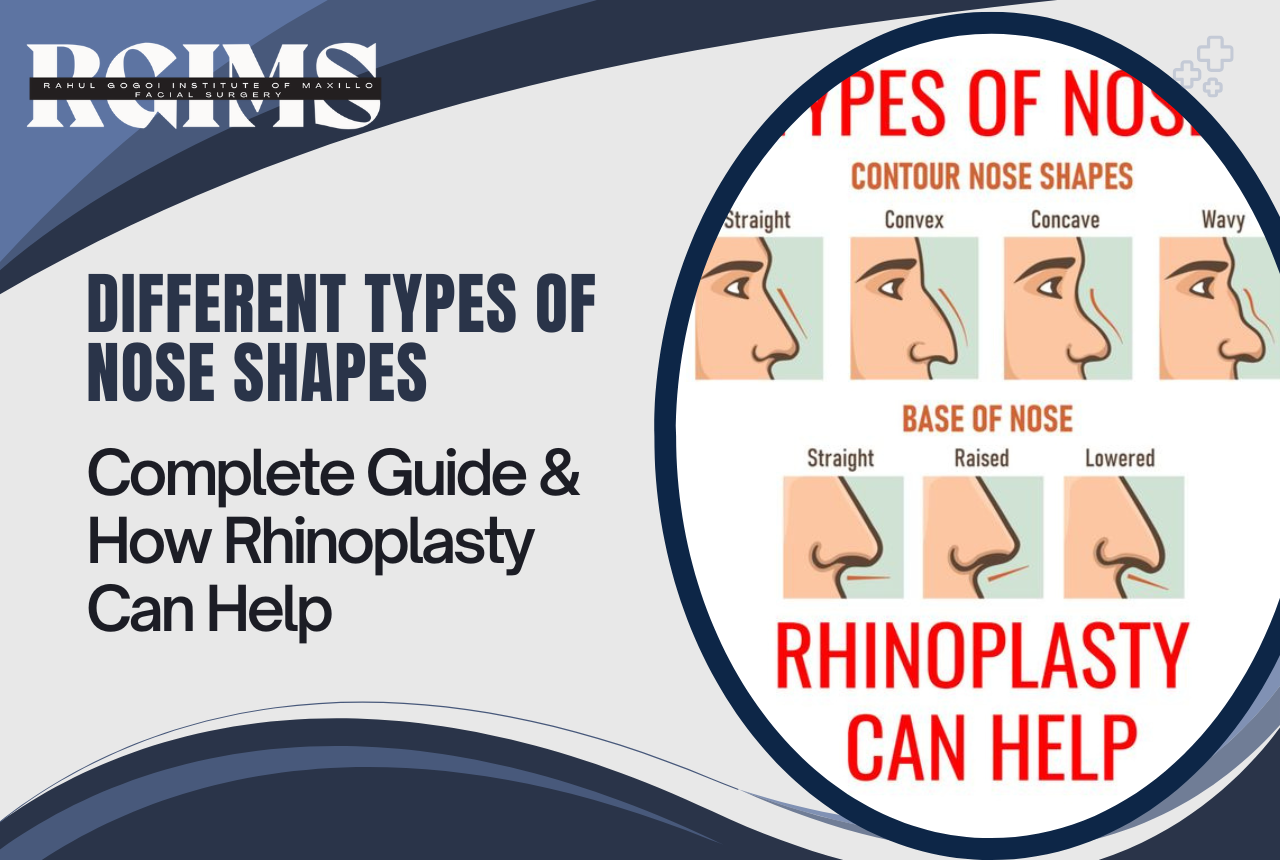
Your nose is the geometric centerpiece of your face. It sits at the intersection of your eyes, cheeks, and lips — and its shape, size, and proportions have an outsized impact on your overall facial harmony. Whether you are exploring rhinoplasty (commonly known as a nose job) or simply curious about the science of facial aesthetics, understanding the different types of nose shapes is an essential first step.
1At RGIMS, India’s leading rhinoplasty center, our board-certified surgeons evaluate thousands of patients each year — each with a unique nose shape and unique aesthetic goals. This comprehensive guide covers every major nose type, common self-image concerns associated with each, and precisely how rhinoplasty can restore confidence and facial balance.
The Science of Nose Classification
Rhinologists and plastic surgeons classify nose shapes based on several anatomical features: the nasal bridge (dorsum), tip projection and rotation, nostril width and shape, columella (the strip of tissue between the nostrils), and overall length and profile. The most widely referenced classification system, developed by Dr. Abraham Tamir, identifies 14 distinct nose types. For practical clinical and aesthetic purposes, we discuss the 12 most commonly encountered types below.
No nose shape is inherently superior or inferior. Beauty standards vary across cultures and evolve over time. However, when a nose shape causes physical discomfort — difficulty breathing, recurring sinus issues — or significant psychological distress, rhinoplasty offers safe, evidence-based solutions.
The 12 Major Types of Nose Shapes: A Complete Guide
Below, each nose type is described alongside common concerns reported by patients and the specific rhinoplasty techniques used to address them.
| 1. The Fleshy / Bulbous Nose | |
| Characteristics The most common nose type globally, the fleshy nose is characterised by soft, rounded contours with a pronounced, rounded tip. The skin is often thicker, and the nasal cartilage is less defined. This nose type appears frequently in people of European, East Asian, and African heritage. Common Concerns Tip appears overly round or ‘blobby’, drawing unwanted attentionLack of definition makes the midface look heavySkin thickness obscures cartilage refinement after surgery (requires specialist care)May contribute to a wider-than-desired nasal appearance | How Rhinoplasty Helps Tip rhinoplasty: reshaping the lower lateral cartilages to create a refined, narrower tipDe-fatting of skin to improve definition on thicker skin nosesDome suturing techniques to lift and sharpen tip projectionNon-surgical option: hyaluronic acid filler to add definition (temporary) |
| 2. The Button Nose | |
| Characteristics Small, petite, and slightly upturned, the button nose is often considered a marker of youthful attractiveness in Western beauty standards. The tip is well-defined but small, and the nose sits neatly above the upper lip. Common Concerns May appear disproportionately small on a larger faceUpturned angle can look overly ‘cute’ or juvenile in adult patientsNostrils may appear more visible from the front due to the upward rotation | How Rhinoplasty Helps Tip deprojection to subtly reduce excessive upward rotationNostril reduction (alarplasty) to minimise visible nostrilsStructural rhinoplasty to add length and balance with facial proportionsOften minimal intervention needed — most button noses require only minor refinement |
| 3. The Roman / Aquiline Nose | |
| Characteristics Characterised by a prominent bridge with a downward-sloping or hooked tip, the Roman nose (also called the aquiline nose from the Latin for ‘eagle’) is historically associated with strength and aristocracy. It is common in Mediterranean, Middle Eastern, and South Asian populations. Common Concerns The hook or downward tip can dominate facial profile viewsTip droops further with age due to loss of structural supportPatients often desire a smoother profile without losing ethnic characterBridge prominence may make other features appear less balanced | How Rhinoplasty Helps Hump reduction rhinoplasty: carefully shaving the nasal dorsum for a smooth profileTip rotation: lifting the drooping tip to an aesthetically pleasing angleOsteotomy (bone narrowing) to close open roof after hump reductionPreservation rhinoplasty techniques to maintain ethnic identity while refining shape |
| 4. The Snub / Pug Nose | |
| Characteristics The snub nose is short with a slightly upturned, round tip and wide nostrils. Unlike the button nose, the snub nose has a flatter bridge and wider base. It is common across East Asian populations and is often associated with a youthful, approachable appearance. Common Concerns Low nasal bridge can flatten midface appearanceWide nostrils may appear disproportionateShort nasal length can make the face look rounderPatients may request augmentation to add height and definition | How Rhinoplasty Helps Dorsal augmentation using silicone implants or rib/ear cartilage grafts to raise the bridgeTip projection rhinoplasty to lengthen and refine the tipAlarplasty to narrow wide nostrils proportionallyAsian rhinoplasty (a specialised subspecialty at RGIMS) addresses the full aesthetic profile |
| 5. The Greek / Straight Nose | |
| Characteristics Often considered the aesthetic ‘ideal’ in classical sculpture, the Greek nose features a perfectly straight bridge with no bumps or curves, a refined tip, and well-proportioned nostrils. It is relatively rare in its natural, perfect form. Common Concerns Very few concerns — this is the shape most rhinoplasty patients request as a referenceMinor asymmetries that disrupt the straight linePost-traumatic deviation from the ideal straight profile | How Rhinoplasty Helps Septorhinoplasty to correct deviated septum and restore straight profileMinor tip refinement to improve symmetryOsteotomy to straighten a crooked bridgeThis nose shape is frequently used as the ‘goal’ image in surgical consultations |
| 6. The Hawk / Eagle Nose | |
| Characteristics Similar to the Roman nose but more dramatic, the hawk nose features a sharp, curved bridge with a pronounced, pointed downward tip. It is most prevalent in Eastern European, Persian, and Native American ethnic groups. Common Concerns Highly pronounced profile that patients often find overpoweringTip points sharply downward, especially evident when speaking or smilingCan appear harsh and dominate facial expressions in photographs | How Rhinoplasty Helps Significant hump reduction to smooth the dramatic curveTip rhinoplasty to lift and soften the sharp, downward-pointing tipColumellar strut graft to provide structural support and maintain liftPreservation rhinoplasty where possible to avoid over-correction |
| 7. The Nubian / Wide Nose | |
| Characteristics Characterised by a wide nasal base, broader bridge, and often a flat or low dorsum, the Nubian nose is associated with African, Caribbean, and some South Asian populations. It reflects rich ethnic diversity and in many cultures is not considered a concern at all. Common Concerns Wide nostrils can feel disproportionate to the rest of facial featuresLow bridge may reduce midface definitionPatients seeking refinement want to preserve ethnic identity while improving balance | How Rhinoplasty Helps Ethnic rhinoplasty: culturally sensitive approach that preserves heritage while achieving patient goalsAlarplasty to reduce nostril width by removing a small crescent of tissue at the baseDorsal augmentation using cartilage grafts (preferred over implants in this nose type)RGIMS surgeons trained in multicultural aesthetics — no ‘one-size-fits-all’ result |
| 8. The Crooked / Deviated Nose | |
| Characteristics Rather than a shape defined by aesthetics, the crooked nose results from trauma, genetics, or a deviated septum. The nose visibly curves or bends to one side and may be accompanied by functional breathing problems. Common Concerns Visible asymmetry is a primary concern for most patientsBreathing difficulties due to septal deviation are commonChronic sinusitis, snoring, and sleep disruptionPost-traumatic crooked noses may worsen with age | How Rhinoplasty Helps Septorhinoplasty: the gold standard — combines structural correction with aesthetic refinementOsteotomy to reposition nasal bones to the midlineSpreader grafts to open the internal nasal valve and improve airflowCartilage grafting to reinforce weakened structural supportInsurance may cover the functional component of surgery at RGIMS |
| 9. The Celestial / Upturned Nose | |
| Characteristics The celestial nose is petite with a concave profile and a noticeably upturned tip, often considered cute and appealing. It differs from the button nose in having a slightly concave dorsum rather than a flat or convex one. Common Concerns Nostrils visible from the front — a concern for many patientsExcessive tip rotation can look unnatural, especially in older patientsNasal length may feel too short in proportion to the face | How Rhinoplasty Helps Tip derotation to reduce the upward angle to a natural, harmonious positionColumellar grafting to add length and reduce nostril showDorsal augmentation to fill the concave bridgeConservative approach recommended — this nose type often requires minimal change |
| 10. The Combo / Mixed Nose | |
| Characteristics Many people do not fit neatly into one category — they have features of multiple nose types. For example, a nose with a Roman hump but a bulbous, fleshy tip, or a straight bridge with a deviated septum. This is referred to as a ‘combo’ or ‘complex’ nose. Common Concerns Multiple simultaneous concerns that require comprehensive surgical planningPrioritising which features to address can be challenging without expert guidanceRisk of over-correction when addressing multiple issues | How Rhinoplasty Helps Comprehensive rhinoplasty planning using 3D imaging simulation at RGIMSStaged procedures or single-session comprehensive rhinoplasty depending on complexityMulti-technique approach: combining hump reduction, tip work, and functional correctionThorough pre-operative consultation to set realistic, prioritised goals |
| 11. The Aging / Drooping Nose | |
| Characteristics Not a static shape but a natural change that occurs with age. As facial ligaments loosen and cartilage weakens over decades, the nasal tip droops downward. This can create the appearance of a hump even where none existed before. Common Concerns Downward tip rotation makes the face appear older and more tiredSmile can be affected as the tip drops further when facial muscles contractPatients who have had previous rhinoplasty may see earlier drooping | How Rhinoplasty Helps Tip rhinoplasty with strong cartilage grafting to provide long-term structural supportColumellar strut graft to stabilise and maintain tip positionCombined with facial rejuvenation procedures for comprehensive anti-aging resultsResults typically last 10-15+ years with appropriate technique |
| 12. The Post-Surgical / Revision Nose | |
| Characteristics Patients who have undergone previous rhinoplasty elsewhere may present with over-resected cartilage, pinched tips, collapsed internal valves, visible implants, or asymmetries. Revision rhinoplasty is among the most technically demanding procedures in facial plastic surgery. Common Concerns Visible deformities from excessive cartilage removal (over-resected nose, polly beak deformity)Breathing difficulties from internal valve collapseAesthetic dissatisfaction with a previous surgical resultPsychological impact from an unsuccessful prior procedure | How Rhinoplasty Helps Revision rhinoplasty using rib cartilage grafts — the gold standard for structural reconstructionInternal valve repair using spreader grafts to restore airflowScar tissue management to improve skin drapingRGIMS offers specialist revision rhinoplasty consultations — extensive pre-op planning essential |
Which Nose Shape Is Most Attractive? The Evidence-Based Answer
This is one of the most searched questions in rhinoplasty and aesthetics. The honest, science-backed answer is: there is no single universally ‘most attractive’ nose shape. Attractiveness is determined by harmony — how well the nose fits the specific proportions of the individual face.
However, research does identify features that are broadly perceived as aesthetically pleasing across cultures:
| Feature | Ideal Range / Description | Why It Matters |
| Naso-facial angle | 30–40° from vertical | Determines nose projection relative to forehead and chin |
| Naso-labial angle | 90–95° in men; 95–105° in women | Angle between nose and upper lip — affects tip rotation |
| Tip projection | 0.67 x nose length (Goode’s ratio) | Ensures tip neither over- nor under-projects |
| Dorsal line | Straight or very slightly concave | Smooth profile viewed from the side |
| Nostril width | Equal to inter-canthal distance | Nostrils align with inner eye corners for balance |
| Tip definition | Two light-reflecting points visible | Creates the appearance of a refined, defined tip |
Why Choose Rhinoplasty? Beyond Aesthetics
Many patients approach rhinoplasty purely for cosmetic reasons — and that is entirely valid. Feeling confident in your appearance has well-documented positive effects on mental health, social interaction, and overall quality of life. However, rhinoplasty also addresses several significant medical and functional concerns:
- Deviated septum correction: improves airflow and reduces chronic nasal obstruction
- Turbinate reduction: addresses chronic congestion that fails to respond to medication
- Internal valve repair: resolves breathing restriction caused by collapsed nasal walls
- Reconstruction after trauma: restores both form and function following injury
- Congenital defect correction: addresses structural issues present from birth
Why RGIMS for Rhinoplasty?
Choosing the right surgeon is the single most important decision in your rhinoplasty journey. At RGIMS, our rhinoplasty team combines decades of surgical experience with the latest techniques in preservation rhinoplasty, ethnic rhinoplasty, and computer-guided surgical planning.
- Board-certified facial plastic surgeons with subspecialty rhinoplasty training
- Advanced 3D imaging and simulation: see your results before surgery
- Comprehensive pre- and post-operative care with dedicated recovery support
- Transparent pricing and detailed consultation with no pressure
- Track record: thousands of successful rhinoplasties across all 12 nose types
Conclusion: Your Nose, Your Confidence
Understanding the different types of nose shapes is the foundation of any informed rhinoplasty decision. Whether you have a fleshy nose, a Roman profile, a wide base, or a crooked bridge — there are evidence-based, safe, and artistically refined surgical solutions available.
At RGIMS, we believe rhinoplasty is not about conforming to a single standard of beauty. It is about creating harmony between your nose and the rest of your unique face — so that you feel as confident as you deserve to feel.
Frequently Asked Questions (People Also Ask)
Q: What is the rarest nose shape?
The ‘turned-up’ or celestial nose is considered one of the rarest nose shapes naturally occurring in adults, accounting for approximately 13% of the population in major nose shape studies. The perfectly straight Greek nose in its natural form is also uncommon.
Q: Which nose shape is considered most attractive?
Research consistently shows that a straight dorsal profile with a slight concavity, a tip rotation of 95–105° in women and 90–95° in men, and nostrils equal in width to the inter-canthal distance are broadly perceived as attractive. However, individual facial harmony matters far more than any single feature.
Q: Can rhinoplasty change your nose type completely?
Yes and no. Rhinoplasty can significantly alter the appearance of your nose type — for example, transforming a bulbous nose into a refined, defined shape. However, certain structural factors (particularly thick nasal skin) place limits on how dramatically the external appearance can change. Your surgeon will provide honest expectations at consultation.
Q: What is the difference between open and closed rhinoplasty?
Open rhinoplasty involves a small incision on the columella (the strip of tissue between the nostrils), allowing full access to nasal structures. Closed rhinoplasty uses incisions entirely inside the nostrils. Open rhinoplasty is preferred for complex cases; closed rhinoplasty offers faster recovery and no external scar.
Q: At what age can you get a rhinoplasty?
Most surgeons recommend waiting until the nose has fully developed — typically 16–18 years for women and 17–19 years for men. There is no upper age limit; rhinoplasty is increasingly popular among patients in their 40s, 50s, and beyond as part of overall facial rejuvenation.
Q: Is rhinoplasty painful?
Rhinoplasty is performed under general anaesthesia, so the procedure itself is painless. Post-operative discomfort is generally mild to moderate — most patients describe pressure rather than sharp pain. Significant improvement is seen within the first two weeks, and most patients return to work within 10–14 days.