
You’ve been thinking about it for months — maybe years. The bump on your nose, the tip that doesn’t match how you feel inside, or the breathing issue that no one else seems to notice but you do. You’ve Googled ‘nose job’ more times than you’d like to admit. But somewhere along the way, you came across the term open rhinoplasty — and now you’re wondering: is that what I actually need?
You’re not alone. This is one of the most searched cosmetic surgery questions in India right now, and for good reason. Rhinoplasty — specifically the open technique — is the gold standard for precise, lasting nose reshaping. But there’s a lot of misinformation out there, and most articles either go too technical or stay frustratingly vague.
This guide cuts through the noise. By the time you finish reading, you’ll know exactly what open rhinoplasty is, how it differs from other nose surgeries, what the recovery actually looks like, and how to find a qualified surgeon right here in Guwahati, Assam.
What Is Open Rhinoplasty?
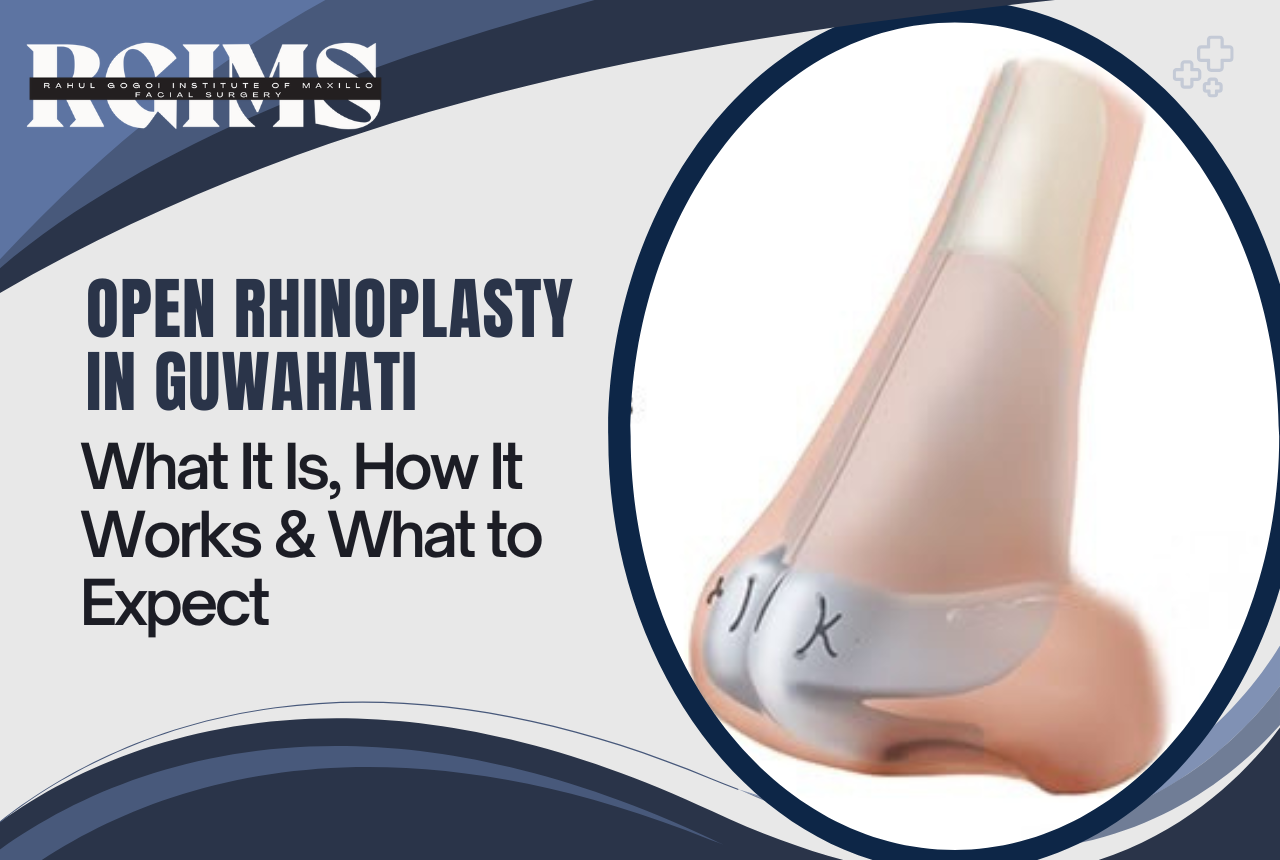
Open rhinoplasty is a surgical technique used to reshape the nose by making a small incision across the columella — the narrow strip of tissue that separates your nostrils. This external cut allows the surgeon to lift the skin off the nasal framework, giving direct, unobstructed access to the cartilage and bone underneath.
Think of it like this: if your nose were a car engine, the closed rhinoplasty approach would be like working through a small gap in the hood. Open rhinoplasty lifts the hood entirely — giving the surgeon full visibility and precise control.
This technique is particularly useful when significant structural changes are needed: refining a nasal tip, correcting a deviated septum, reducing a hump, or rebuilding the nose after trauma.
Open vs. Closed Rhinoplasty: What’s the Difference?
Many patients come in asking about the difference between these two approaches. Here’s a plain-language breakdown:
- Open Rhinoplasty: External incision on the columella. Full visibility of nasal structures. Preferred for complex reshaping and revision surgeries.
- Closed Rhinoplasty: All incisions inside the nostrils. No external scar. Best for minor adjustments with less swelling and faster recovery.
The right choice depends entirely on your anatomy and goals. A skilled surgeon at a trusted clinic in Guwahati will assess your nasal structure and recommend the appropriate technique during your consultation.
Why Open Rhinoplasty Matters: The Real Benefits1
Open rhinoplasty isn’t just a surgical choice — it’s a precision tool. Here’s why it’s considered the preferred approach for most complex nose surgeries:
- Surgeon Visibility: The lifted skin exposes the entire nasal anatomy, reducing guesswork and improving accuracy.
- Better Control Over the Tip: Nasal tip refinement is one of the most technically demanding parts of rhinoplasty. Open access allows surgeons to sculpt cartilage with millimetre-level precision.
- Ideal for Revisions: If a previous nose surgery didn’t deliver the expected results, open rhinoplasty is almost always required to correct it.
- Handles Complex Cases: Deviated septums, asymmetry, post-trauma reconstruction — these all benefit from the superior access open rhinoplasty provides.
- More Predictable Results: Because the surgeon can see and control every structure, outcomes tend to be more consistent with what was planned pre-operatively.
Open Rhinoplasty: Step-by-Step Guide to the Procedure
Understanding the procedure helps reduce anxiety and set realistic expectations. Here is what typically happens from the first consultation to your final results.
Step 1: Initial Consultation
Your journey begins with a detailed consultation with a plastic surgeon. During this session:
- Your nasal anatomy will be assessed (internally and externally)
- Your medical history and any breathing issues will be reviewed
- Digital imaging may be used to simulate potential outcomes
- The surgeon will explain which technique — open or closed — suits your case
In Guwahati, reputed clinics like RGIMS offer consultations where surgeons take the time to understand your goals, not just your anatomy.
Step 2: Pre-Operative Preparation
Once you decide to proceed, your surgeon will guide you through preparation:
- Blood tests and health screening
- Stop smoking at least 4 weeks before surgery (smoking impairs healing)
- Avoid blood thinners like aspirin and ibuprofen for 2 weeks
- Arrange for a responsible adult to accompany you on surgery day
Step 3: Anaesthesia
Open rhinoplasty is performed under general anaesthesia in most cases, meaning you will be completely asleep and comfortable throughout the procedure. Some centres may use sedation with local anaesthesia for minor corrections — your surgeon will advise.
Step 4: The Incision
A small, zig-zag (or inverted-V) incision is made on the columella — the skin bridge between your nostrils. This heals very well over time and typically becomes nearly invisible within 6–12 months. Additional internal incisions are made inside the nostrils as needed.
Step 5: Reshaping the Structure
With the skin lifted, the surgeon directly accesses the cartilage and bone. Depending on your goals, this may involve:
- Removing or refining nasal cartilage for tip reshaping
- Shaving or rasping bone to reduce a hump
- Repositioning or grafting cartilage to add projection or support
- Correcting a deviated septum (septoplasty) if needed
Step 6: Closing and Dressing
Once reshaping is complete, the skin is re-draped over the new framework. Incisions are closed with fine sutures. A small splint or cast is applied to protect the nose and maintain its new shape during initial healing.
Step 7: Recovery
Recovery happens in phases. Here is a realistic timeline:
- Days 1–3: Swelling and bruising around the nose and eyes. Rest is essential.
- Days 7–10: Splint removed. Sutures removed. You will look presentable, but swelling is still present.
- Week 3–4: Most bruising resolves. You can return to work and social activities.
- Month 3–6: Significant swelling reduces. Shape becomes clearer.
- Month 12–18: Final results visible. Tip refinement and subtle swelling fully resolve.
Tips & Best Practices Before and After Open Rhinoplasty
Getting the best result from your rhinoplasty starts well before you enter the operating theatre. Here are practical, experience-backed tips:
Before Your Surgery
- Choose a surgeon with specific rhinoplasty experience — not just general plastic surgery credentials
- Ask to see before-and-after photos of real patients with similar nose types
- Be honest about your expectations — bring reference images to your consultation
- Understand that rhinoplasty enhances your existing features; it does not transform your face
- Get a second opinion if you feel rushed or pressured
After Your Surgery
- Sleep with your head elevated for at least 2 weeks to reduce swelling
- Avoid blowing your nose for 3–4 weeks
- Protect your nose from sun exposure — use SPF 50 on the scar area after it heals
- Avoid glasses resting on your nose for 6–8 weeks (use tape or contacts)
- Attend every follow-up appointment — your surgeon needs to monitor healing
- Be patient. The final shape takes up to 18 months to fully emerge
Common Mistakes Patients Make (And How to Avoid Them)
Rhinoplasty is one of the most technically challenging cosmetic procedures. Mistakes — on both the patient’s and surgeon’s side — can lead to suboptimal results. Here are the most common pitfalls:
1. Choosing Based on Price Alone
Going to the cheapest available surgeon is the number one cause of revision surgeries in India. A lower price often means less experience, fewer safety protocols, or the use of inferior materials for grafts. Rhinoplasty is a long-term investment — choose based on skill and safety, not cost.
2. Unrealistic Expectations
Rhinoplasty can dramatically improve your nose — but it cannot make you look like a celebrity or completely change your facial structure. Patients who bring in edited photos or expect perfection are often disappointed. A good surgeon will have an honest conversation about what is and is not achievable for your face.
3. Not Disclosing Medical History
Conditions like bleeding disorders, autoimmune diseases, or a history of keloid scarring can significantly affect surgical outcomes and recovery. Always disclose your full medical history, including supplements and herbal medicines — some of these interact with anaesthesia.
4. Rushing Back to Normal Activities
The nose is highly vascular and takes time to heal. Returning to strenuous exercise, heavy lifting, or contact sports too soon can cause bleeding, shifting of the nasal structure, or prolonged swelling. Follow your surgeon’s timeline — not your own impatience.
5. Ignoring the Surgeon’s Credentials
In India, any doctor can technically perform cosmetic procedures. Always verify that your surgeon is an MCh (Plastic Surgery) or DNB (Plastic Surgery) qualified specialist registered with the Medical Council of India. At RGIMS Guwahati, our surgeons hold the appropriate credentials and specialise in facial plastic procedures.
Conclusion
Open rhinoplasty is one of the most powerful and precise tools in modern cosmetic and reconstructive surgery. Whether you’re bothered by a bump on your nose, struggling with breathing difficulties, or unhappy with your nasal tip — this procedure, when performed by a skilled surgeon, can create lasting, natural-looking results.
The key is preparation: understanding the procedure, setting realistic expectations, and — most importantly — choosing the right surgeon.
If you’re in Guwahati or anywhere in Assam and considering rhinoplasty, you don’t need to travel to Delhi or Mumbai. Expert care is available closer to home.
Frequently Asked Questions
1. Is open rhinoplasty painful?
The surgery itself is performed under anaesthesia, so you feel nothing during the procedure. Post-operative discomfort is usually mild to moderate — most patients describe it as pressure or congestion rather than sharp pain. Prescribed medication manages this effectively for the first few days.
2. How long does open rhinoplasty take?
Depending on the complexity of the case, open rhinoplasty typically takes between 2 to 4 hours. Revision rhinoplasty may take longer due to scar tissue and the complexity of correcting prior work.
3. Will there be a visible scar?
The columellar scar is placed very discreetly and heals remarkably well in most patients. By 6 to 12 months post-surgery, it typically fades to a thin, pale line that is barely noticeable — even at close range. Proper scar care (sunscreen, silicone gel if advised) accelerates this process.
4. What is the cost of open rhinoplasty in Guwahati?
Rhinoplasty costs in Guwahati vary based on the surgeon’s experience, facility type, complexity of the case, and anaesthesia requirements. For a personalised quote that reflects your specific needs, we recommend booking a consultation at RGIMS where our team will assess your case and provide transparent pricing.
5. Can open rhinoplasty fix breathing problems?
Yes — when combined with septoplasty (correction of a deviated septum), open rhinoplasty can significantly improve nasal breathing. In fact, many patients pursue this surgery for functional reasons, not just cosmetic ones. Insurance may partially cover functional procedures in some cases — consult your insurer.
6. What is the right age for open rhinoplasty?
Most surgeons recommend waiting until nasal growth is complete — typically around 17–18 years for females and 18–19 years for males. There is no upper age limit, provided the patient is in good general health.
7. How do I find the best rhinoplasty surgeon in Guwahati?
Look for an MCh or DNB qualified plastic surgeon with documented experience in rhinoplasty, a portfolio of patient outcomes, and a clinic with proper hospital infrastructure. RGIMS in Guwahati offers all of this, along with pre- and post-operative support tailored to each patient’s journey.